AI Detection Guides
Is GPTZero Accurate?
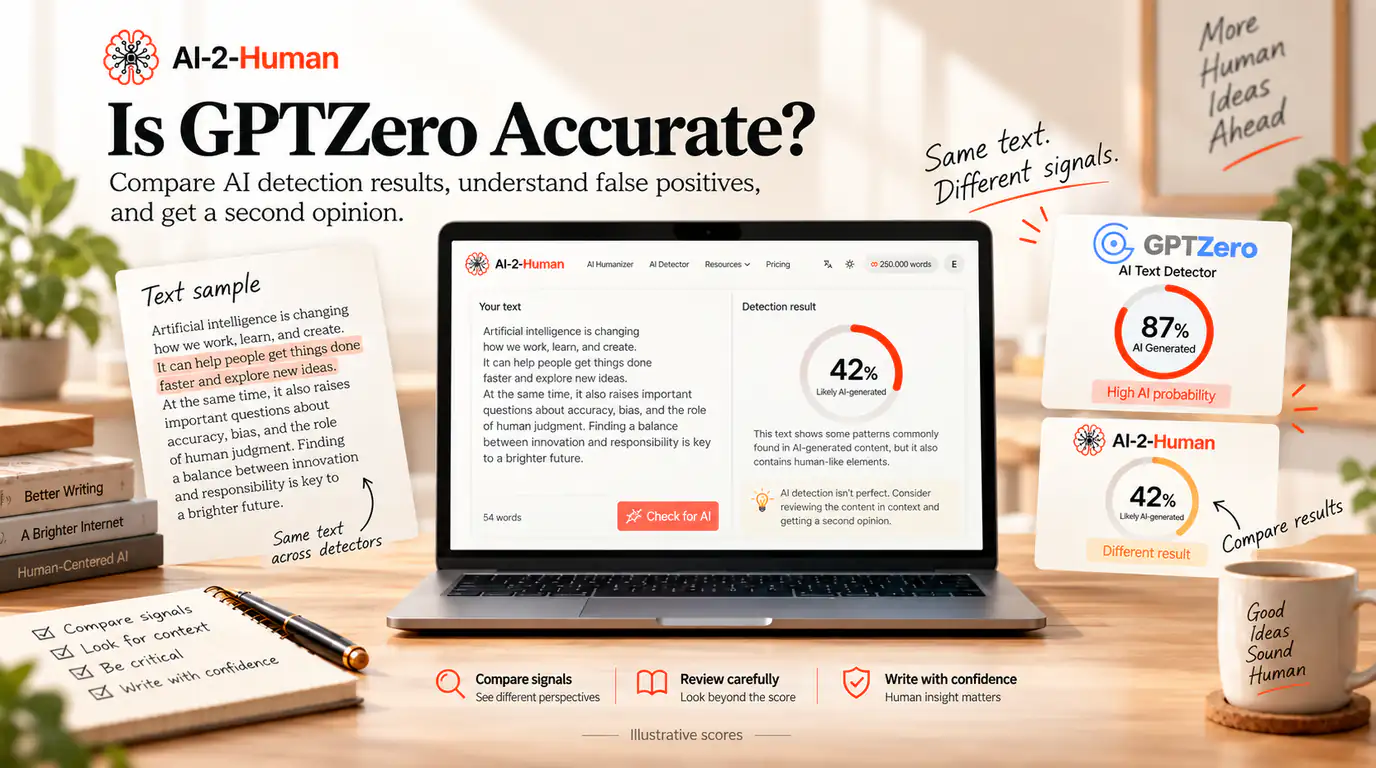
GPTZero can identify AI-generated writing accurately in many situations, but there is no single accuracy percentage that applies to every text. GPTZero’s own benchmark reports very strong results on four English domains, while independent studies show performance moving with the detector version, the writing type, the text length and the dataset tested. False positives and false negatives are both documented. That makes GPTZero useful as a detection signal, but not unquestionable proof of how a text was written. When the result matters, running the same passage through the AI-2-Human Detector gives you another signal before you conclude anything.
What is GPTZero?
GPTZero is an AI text detector. You paste a text or upload a document, and its deep-learning system estimates how much of that text was written by a machine. It returns one of three document classifications (written entirely by a human, written entirely by an AI, or written by a mix of both) along with a confidence category, and it highlights the sentences that contributed most to the result. GPTZero also describes additional detection capabilities aimed at text that has been altered by paraphrasing tools.
How accurate is GPTZero?
There is no single GPTZero accuracy percentage that applies to every text. Reported results depend on the detector model version, how the benchmark was constructed, which human writing it used, which AI model generated the machine text, the genre, the text length, whether the text was edited or paraphrased afterwards, the classification threshold the testers chose, and the language being tested.
That is why this guide keeps two kinds of evidence separate. The first is what GPTZero reports about its own model, on its own benchmark, with a stated model version. The second is what independent researchers measured when they ran GPTZero on their own texts, which is a different question: they tested the version available at the time, on their dataset, at a threshold they selected. Both are useful, and neither replaces the other.
The short answer for a reader with a specific document is therefore conditional: GPTZero can be highly effective on writing similar to what it was trained and benchmarked on, and its published documentation acknowledges that short samples, heavily modified AI text, unusual genres and procedural writing are harder cases.
What GPTZero’s current benchmark reports
GPTZero publishes a standardized benchmarking page that it says is updated quarterly, with raw predictions available for researchers who want to reproduce the results. In its February 2026 evaluation, GPTZero reports an average across four English domains for model version 4.3b of a 0.08% false-positive rate, 99.60% recall, 99.93% precision and 99.76% accuracy. Each benchmark uses 1,000 human texts and 1,000 LLM-generated texts, split evenly across the models being tested (250 texts per model), and the model set is refreshed quarterly.
The per-domain rows are published separately, which matters because averages hide variation. GPTZero reports 99.85% accuracy on academic paper reviews (0.10% false positives), 99.80% on creative writing, 100% on essays with a 0.00% false-positive rate, and 99.40% on product reviews. The same page reports the scores it measured for competing detectors on the identical texts, and the comparison is closer on some domains than the headline average suggests.
GPTZero: AI detection benchmarking, the industry standard in accuracy, transparency and fairness
What independent research says about GPTZero accuracy
The strongest independent result for GPTZero comes from a peer-reviewed study published in Acta Neurochirurgica in 2025. The researchers assembled 1,000 texts: 250 human-written abstracts and introductions from four high-impact neurosurgery journals published before ChatGPT, plus 750 versions of the same material generated by ChatGPT 3.5, GPT-4 and GPT-4o. The detectors were used between 1 and 15 June 2024, which dates the GPTZero version tested. With GPTZero, the average AI-likelihood score was 5.88% for the human texts, 81.71% for GPT-3.5, 96.83% for GPT-4 and 99.58% for GPT-4o. At the cutoff the researchers selected, GPTZero reached 100% sensitivity and 99.6% specificity.
Acta Neurochirurgica: accuracy and limitations of AI-output detectors
That is a strong result, and it is still conditional. It describes one academic dataset, in one discipline, at particular text lengths, against three ChatGPT versions, on the GPTZero version available in June 2024, at a threshold chosen by the authors. It does not mean the detector is 99.6% accurate on your text, and the same paper notes that no detector it evaluated was reliable in every situation.
Earlier independent work shows how different those conditions can look. A preliminary study published in the Journal of Korean Medical Science in 2023 tested GPTZero on 20 texts generated by ChatGPT in response to medical questions and 30 pieces taken from previously published medical articles. It reported a sensitivity of 0.65 (95% confidence interval 0.41 to 0.85), a specificity of 0.90 (0.73 to 0.98) and an accuracy of 0.80 (0.66 to 0.90), and concluded that GPTZero had a low false-positive rate but a high false-negative rate: it rarely accused human writing, and it often missed machine writing.
Journal of Korean Medical Science: GPTZero performance on AI-generated medical texts (2023)
The gap between that 2023 snapshot and the 2025 study is not a contradiction, and it is not proof that one team was careless. It is the clearest illustration on this page of why a detector’s accuracy has to be read together with its version and its dataset.
Can GPTZero flag human writing as AI?
Yes. A false positive is human writing classified as AI or mixed, and GPTZero acknowledges that these cases exist. Its support documentation explains that accuracy increases as more text is submitted, that its classifier is trained mainly on English prose written by adults, and that it can sometimes flag other machine-generated or highly procedural text as AI-written. A short extract, a formulaic passage or a text far from that training distribution is where this risk concentrates.
GPTZero: what are the limitations of its AI classifier?
GPTZero’s public documentation goes further than most vendors on the consequence of that risk. It states that results should not be used to punish students, recommends treating a classification as one component of a broader assessment, and says the detector should be used as a starting point for a conversation rather than as a final verdict. In academic settings the company also says it prefers missing AI use to accusing a human: its API documentation advises against increasing detector sensitivity for academic use cases, because false negatives are preferable to false positives there.
Can GPTZero miss AI-generated writing?
Yes, and the vendor’s own trade-off makes that explicit: a false negative is AI-generated text classified as human, and GPTZero states that in an academic context it would rather err in that direction. The 2023 medical study measured the practical cost of the same preference, reporting a 0.65 sensitivity on its dataset: roughly a third of the machine-written texts were not flagged.
Several factors push a generated passage towards a human classification. Text that was generated and then substantially rewritten by hand no longer looks like raw model output, and GPTZero’s documentation notes that its classifier was not trained to identify AI-generated text after heavy modification. Paraphrasing tools, unfamiliar models, unusual genres, short samples and deliberate adversarial edits all sit in the same zone. The company updates its models for these cases, which is also why a result from one version does not automatically carry over to the next.
Why GPTZero accuracy varies
When two studies report very different numbers for the same tool, the explanation is usually in the test design rather than in the tool. The variables below cover most of the gap.
- Model version: the detector tested in 2023, the one tested in June 2024 and the current model are different systems, and GPTZero documents version changes itself.
- Benchmark construction: which texts were chosen, how the AI texts were prompted, and whether the samples are balanced across genres all shape the result.
- Human writing used as a control: pre-ChatGPT academic prose, student essays and web writing are different distributions, and a classifier can look excellent on one and weak on another.
- Generating model: the Acta Neurochirurgica study measured average GPTZero scores rising from 81.71% for GPT-3.5 to 99.58% for GPT-4o, so the same tool reads different models differently.
- Genre and language: GPTZero states that it performs best on longer texts and English prose, which is where most of its training data sits.
- Text length: more text means more evidence, which is why document-level results are more reliable than sentence-level ones.
- Editing and paraphrasing: heavy human rewriting or an automated paraphrase moves a text away from the patterns the classifier learned.
- Threshold: every detector converts scores into decisions at some cutoff, and moving that cutoff trades false positives against false negatives. The Acta study reported its own cutoff, which is one reason its numbers are precise rather than universal.
- What counts as correct: studies treat mixed classifications, partial AI text and uneven documents differently, so two papers can measure the same tool and still mean different things by accuracy.
Does text length affect GPTZero accuracy?
Yes, and GPTZero says so directly. Its documentation states that accuracy improves as more text is submitted, and that document-level classifications are generally more reliable than paragraph-level ones, which in turn are more reliable than sentence-level classifications.
The practical consequence is worth remembering the next time you see a highlighted sentence. A single highlighted sentence is a weak signal on its own, because it carries the least evidence of anything the detector examines. A consistent document-level classification on a full essay, where the same patterns appear across several paragraphs, deserves more weight. If the text you are checking is short, treat the result as provisional and check more of it.
How to interpret a GPTZero result
GPTZero does not return a single number, and reading its output as “X percent of this essay was written by AI” is a misunderstanding. The system returns a classification (human only, mixed, or AI only), a probability for each of those classes, and a confidence category of high, medium or low. The class probability attached to the predicted class is described by GPTZero as the chance that the detector is correct in that prediction: a 90% figure means that on similar documents it is right about 90% of the time.
GPTZero: how do I turn the probabilities from your API into outcomes?
GPTZero also publishes what its confidence categories mean in practice: at high confidence, it reports that 99.1% of human articles are classified as human and 98.4% of AI articles are classified as AI. A medium or low confidence result is, by construction, a softer statement, and the documentation describes thresholds you can adjust to trade sensitivity against false positives for your own use case.
Questions worth asking before you act on a result:
- How long is the text, and is the verdict document-level or sentence-level?
- Is the confidence high, medium or low?
- Which passages triggered the classification?
- Does the writing genuinely look repetitive or formulaic when you read those passages?
- Does another detector return a similar signal on the same text?
- Is there evidence of the writing process, such as drafts, notes or a version history?
- Was the text substantially edited or paraphrased after it was generated?
What a GPTZero result cannot establish, on its own, is plagiarism, misconduct, intent or the exact history of a document. It is evidence about patterns in the text, and it is most useful when read next to the text itself.
Should teachers use GPTZero as proof of AI use?
Not as proof, and GPTZero’s own documentation says the same thing. Its support pages state that no detector is fully accurate, that results should not be used to punish students, and that a classification is best treated as one element of a broader assessment. The company also documents its error preference in academic settings: it would rather let AI-assisted writing through than accuse a student wrongly, which is exactly the opposite of what a disciplinary decision needs.
When authorship matters, a process is stronger than a score. Useful evidence includes drafting history, document revisions, source notes, earlier work by the same student, citations that can be checked, discussion of the material, and whatever the assignment’s AI policy actually permits. A detector can point to passages worth discussing. It cannot replace the conversation.
What to do if GPTZero flags your text
If the result matters, work through it in a fixed order rather than rewriting on reflex.
- 1
Read
Read the flagged passages and judge them as writing.
- 2
Check the level
Note whether the classification is document-level or sentence-level.
- 3
Weigh confidence
Look at the confidence category, not only the headline result.
- 4
Compare
Run the same text through a second detector.
- 5
Evidence
Gather drafts and version history if authorship is questioned.
- 6
Revise
Rewrite only the passages that genuinely need improvement.
Sometimes the concern is fair: repeated sentence shapes, transitions that connect nothing, claims with no example behind them. When a passage really is formulaic, AI-2-Human Humanizer can rewrite it into a more natural draft while keeping your intended meaning at the centre, and you then edit the result in your own voice.
Should you compare GPTZero with another AI detector?
Yes, especially when the result carries consequences. Detectors use different models, different training data and different decision thresholds, so the same passage can produce different results. The studies on this page are themselves an example of how much conditions matter: the same tool scored very differently across datasets and versions.
A comparison helps in both directions. When two detectors highlight the same passage, that passage is worth a careful look. When they disagree sharply, the disagreement tells you the text sits near a decision boundary and that the score is soft, which is useful to know before you rewrite anything or before someone else acts on the result.
AI-2-Human’s Detector reports its own reading of the text and points to the passages that still look generated, which gives you two interpretations to set side by side before deciding what to change.
Before you submit: a practical checklist
- I checked whether the result is document-level or sentence-level.
- I considered the length and the type of text being checked.
- I looked at GPTZero’s confidence, not only the headline classification.
- I read the passages that triggered concern.
- I treated the result as evidence rather than proof.
- I compared another detector because the outcome matters.
- I kept drafts or version history where authorship could be questioned.
- I verified facts and citations separately from AI detection.
- I revised only the passages that genuinely needed improvement.
Frequently asked questions
GPTZero performs very strongly on its own benchmarks and on at least one independent academic dataset, but there is no universal accuracy percentage for every kind of text. Reported results move with the detector version, the writing type, the text length and the dataset, and both false positives and false negatives are documented. A result is best treated as one signal rather than as proof.
It depends on the test, which is why the useful answer is a comparison rather than a number. GPTZero’s February 2026 benchmark reports 99.76% average accuracy with a 0.08% false-positive rate across four English domains for model 4.3b. An independent 2024 study on 1,000 academic texts measured 100% sensitivity and 99.6% specificity at its own cutoff. A 2023 preliminary medical study reported 80% accuracy and 65% sensitivity on an older version. Same tool, different versions and different conditions.
GPTZero reports a 0.08% average false-positive rate in its own February 2026 benchmark, and 0.00% on its essay domain. Independent studies put the risk differently depending on the dataset and the cutoff, and GPTZero’s support documentation acknowledges that human writing can be classified as AI, which is why it advises against using a classification as the sole basis for a decision about a student.
Yes, in both directions. GPTZero’s documentation acknowledges false positives and false negatives, notes that no detector is fully accurate, and states that results should not be used to punish students. Independent studies have measured both error types on real datasets.
Yes. GPTZero acknowledges that edge cases exist, and its documentation explains that accuracy improves with more text and that its classifier is trained mainly on English prose written by adults. Short extracts, formulaic writing and highly procedural text are where a false positive is most likely.
Formal, highly polished or repetitive prose can resemble the patterns the classifier associates with machine writing, and a short sample gives it little to work with. GPTZero’s own guidance is to use the result as one element of a wider assessment. If a passage is genuinely repetitive, improving it helps; if it is simply formal, the classification says more about the limits of the detector than about your writing.
Check with the AI Detector →Yes. A false negative is AI-generated text classified as human, and GPTZero states that in academic use it prefers that error to a false accusation. The 2023 medical study measured the practical cost with a sensitivity of 0.65 on its dataset. Heavy human editing, paraphrasing tools and unfamiliar models all make a generated passage harder to flag.
In GPTZero’s own February 2026 benchmark, the essay domain is the strongest of the four, with 100% accuracy and a 0.00% false-positive rate for model 4.3b. That is a company-reported result on its own essay dataset, so it describes that benchmark rather than every essay. Independent results on academic prose are strong but vary with the version and the cutoff used.
Less accurate than for long text, by GPTZero’s own account. Its documentation states that accuracy improves as more text is submitted, and that document-level classifications are more reliable than paragraph-level ones, which are in turn more reliable than sentence-level classifications. A highlighted sentence on its own is a weak signal.
GPTZero is built to classify text from multiple language-model families, and the Acta Neurochirurgica study measured average GPTZero AI-likelihood scores rising from 81.71% for GPT-3.5 to 96.83% for GPT-4 and 99.58% for GPT-4o. That does not mean every ChatGPT passage is flagged, or that a flagged passage proves ChatGPT was used.
In the datasets cited in this series, GPTZero’s reported metrics were higher than ZeroGPT’s, including 100% against 94.4% sensitivity in the 2024 academic study and 97.22% against 64.35% accuracy in a 2025 study on scholarly abstracts. That is a result about those tests rather than a permanent ranking: the products use different systems, and benchmarks, thresholds and versions change. Compare on your own text instead of assuming an order.
Yes, and that is expected. Different models, training data and thresholds mean the same passage can be read differently by two tools. GPTZero’s own benchmark page reports the comparisons it ran against other detectors, and the margins differ by domain, which is a good illustration of how much the dataset shapes the outcome.
Not as sole evidence. GPTZero’s documentation recommends using its classifier as one component of a broader assessment and states that results should not be used to punish students. A workable process combines a detector signal with drafting history, revision records, source notes, earlier work by the same student, and a conversation about the material.
Read the flagged passages yourself, check whether the classification is document-level or sentence-level, look at the confidence category, compare with another detector, and gather your drafts and version history. Then revise only the passages that genuinely read as formulaic. AI-2-Human can provide a second detection signal, and the Humanizer can handle the rewriting pass if a passage really needs it.
Yes. The AI-2-Human Detector gives you another detection signal on the same text and points to the passages that look generated, so you can set two readings side by side. It reports its own interpretation rather than a copy of GPTZero’s model, which is what makes the comparison useful.
Run the AI Detector →A rewriting tool changes the text, and a different text can be classified differently, but no tool can promise a specific outcome: detectors and thresholds keep changing, and GPTZero updates its models. The dependable approach is to improve writing that genuinely needs it, then check again and compare. AI-2-Human rewrites repetitive, formulaic passages into a more natural version while keeping your meaning.
Humanize AI text →Sources & editorial notes
- GPTZero: AI Detection Technology
- GPTZero: AI detection benchmarking, the industry standard in accuracy, transparency and fairness
- GPTZero: what are the limitations of its AI classifier?
- GPTZero: how do I turn the probabilities from the API into outcomes?
- Acta Neurochirurgica: accuracy and limitations of AI-output detectors
- Journal of Korean Medical Science: GPTZero performance on AI-generated medical texts (2023)
AI-2-Human is not affiliated with or endorsed by GPTZero. GPTZero documentation, benchmark information and the cited research were reviewed on September 20, 2026. Detector models and performance can change over time.
Updated