AI Detection Guides
Is ZeroGPT Accurate?
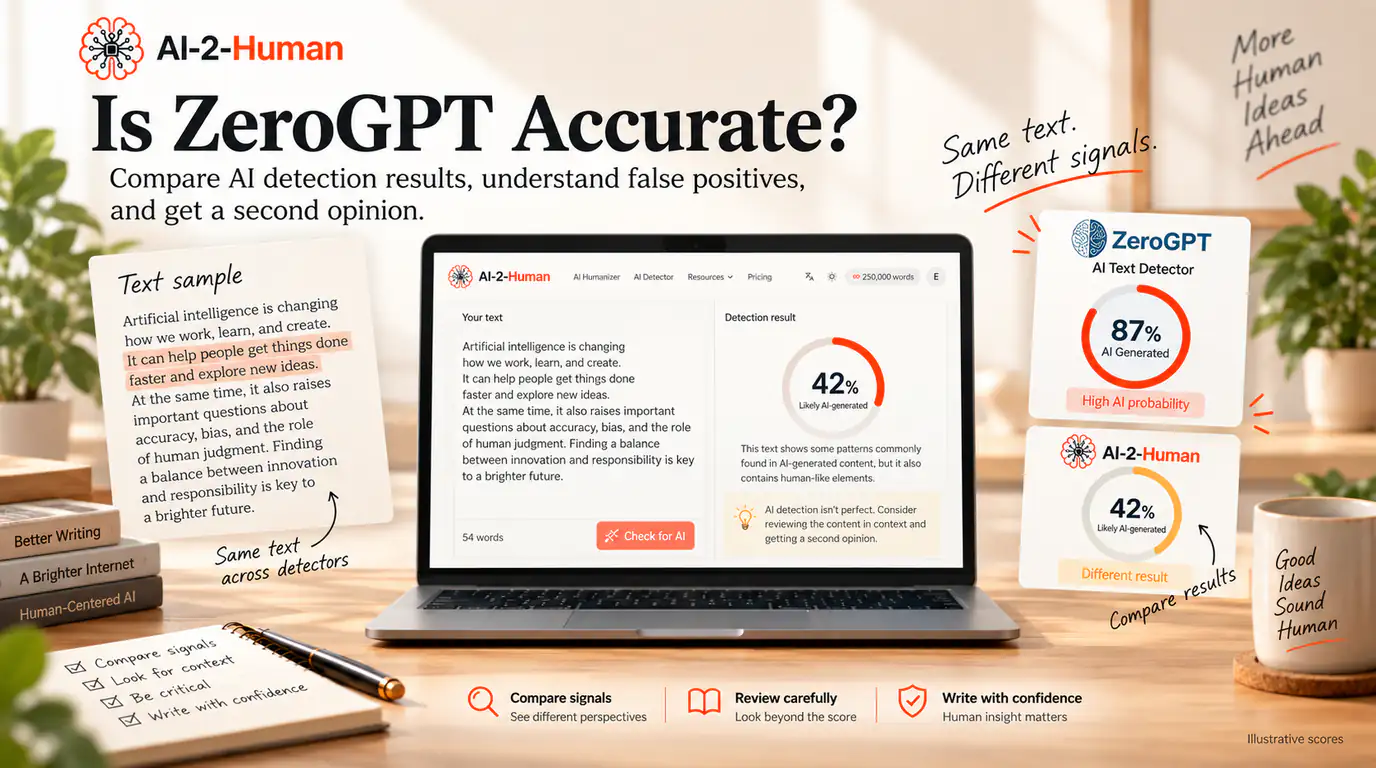
ZeroGPT can separate AI-generated writing from human writing in many cases, but it is not perfectly accurate. Independent studies that put it through academic and scholarly datasets report strong results on one and much weaker results on another, and both false positives and false negatives occur. A ZeroGPT score is therefore most useful as a signal to investigate rather than as proof of how a passage was written. If you want a second opinion, you can run the same text through the AI-2-Human Detector and compare what each tool highlights.
What is ZeroGPT?
ZeroGPT (zerogpt.com) is an AI text detector. You paste a text or upload a file, and it returns an AI likelihood score for the document along with the passages it considers AI-like. The free detector accepts up to 15,000 characters per check, and the interface can generate a PDF report of the result. Its wider toolkit includes a plagiarism checker, a paraphraser and a humanizer.
Its own documentation describes the detector as analysing linguistic and statistical signals learned from human and AI text, including token patterns, burstiness, entropy and ensemble classifier features. What it does not publish is the trained weights or the decision thresholds, which is why the number should be read as an estimate from one model rather than as a measurement of authorship.
How accurate is ZeroGPT?
There is no single ZeroGPT accuracy percentage that applies to every kind of writing. Published estimates range from strong to mediocre, and both ends come from legitimate tests, because a detector’s score depends on the dataset, the genre, the model that produced the AI text, the length of the sample, how heavily it was edited, the threshold the researchers selected and how the study defines AI-generated writing.
ZeroGPT’s own FAQ states that it aims above 98% accuracy on internal evaluations, and its homepage advertises 98.4% detection accuracy with a false positive rate under 1%. Those figures come from the company’s own testing. Independent teams re-running the same tool on their own datasets have reported very different numbers, and those measurements are the ones to read before treating a score as decisive.
So the honest answer is a range with conditions attached: ZeroGPT separated human from ChatGPT-generated academic writing well in one 1,000-text study, and performed much worse on a dataset of scholarly abstracts in another. The next section shows both measurements side by side.
What independent research says about ZeroGPT
The first study, published in Acta Neurochirurgica in 2025, assembled 1,000 texts: 250 human-written abstracts and introductions from four high-impact neurosurgery journals published before ChatGPT, plus 750 versions of the same material generated by ChatGPT 3.5, GPT-4 and GPT-4o. With ZeroGPT, the average AI-likelihood score was 27.55% for the human texts, 81.48% for GPT-3.5, 87.39% for GPT-4 and 94.35% for GPT-4o: a clear separation between the human and the generated groups. At the cutoff the researchers selected, ZeroGPT reached 94.4% sensitivity and 93.2% specificity, so it caught most AI text and correctly cleared most human text.
Acta Neurochirurgica: accuracy and limitations of AI-output detectors
The same paper measured GPTZero at 100% sensitivity and 99.6% specificity on that dataset, which is worth knowing for two reasons: it shows that a single study ranks tools for its own texts rather than in general, and it shows that even a detector scoring near the top of one benchmark still had errors in the wider picture the authors describe.
The second study, published in PeerJ Computer Science in 2025, compared human-written scholarly abstracts with abstracts generated by ChatGPT o1 and Gemini 2.0 Pro Experimental, then looked at a second scenario where the original text had been enhanced by those models to improve readability. On the first dataset, ZeroGPT reached 64.35% overall accuracy, with a false positive rate of 16.67% and a false negative rate of 45.14%. The paper’s subject is the trade-off between accuracy and bias: it reports that the errors were not distributed evenly, falling disproportionately on non-native English writers and on certain disciplines.
PeerJ Computer Science: accuracy-bias trade-offs in AI text detection
A third study, published in Advances in Simulation in 2025, compared ZeroGPT, PhraslyAI and Grammarly’s AI detector across five conditions of AI use, from untouched human introductions to substantially AI-assisted ones, using 30 articles published before 2022. Scores moved with the condition, and the tools did not agree with one another on the same material. That disagreement is the practical lesson of this section: the number is a property of a text, a model and a threshold, not of authorship.
Advances in Simulation: identifying different forms of AI-generated content
None of these papers found a detector that was right every time, including the tools that scored best on their own dataset.
Can ZeroGPT flag human-written text as AI?
Yes. A false positive is human writing classified as AI-generated, and independent research has documented it with ZeroGPT. In a small exploratory study published in the ASEAN Journal of Open and Distance Learning, ten authentic essays written by Filipino undergraduates were submitted to ZeroGPT and to a second detector. All ten were written by students, and the tools split the set in half: five essays were labelled AI-generated and five human. The authors describe the result as a misclassification risk and argue for human judgement rather than detector output as evidence.
ASEAN Journal of Open and Distance Learning: false positives in AI writing detection
Ten essays is a small sample, so read that study as an illustration of the risk rather than a measurement of ZeroGPT’s error rate. The PeerJ dataset is the more quantitative warning: a 16.67% false positive rate on scholarly abstracts, with accuracy varying by author category. ZeroGPT’s own FAQ also acknowledges the mechanism, explaining that highly polished, formulaic or low-entropy writing can resemble AI, and suggesting concrete details, sources and varied sentence rhythm to reduce the risk. Formal, formulaic or second-language writing is exactly where a detector is most likely to be wrong.
Can ZeroGPT miss AI-generated writing?
Yes, in the other direction. A false negative is AI-generated text classified as human, and the same PeerJ study measured a 45.14% false negative rate on its dataset: nearly half of the generated abstracts the test expected to be flagged came back as human. In the Acta Neurochirurgica dataset the separation was much better, with human text averaging 27.55% and GPT-3.5 text averaging 81.48%, but averages hide spread. Individual samples overlap between the two groups, which is precisely why a classifier needs a cutoff and why that cutoff has to trade one kind of error against the other.
AI-generated writing is not one fixed category either. A raw model output, a lightly paraphrased draft and a text that was generated and then rewritten by hand are different objects to a classifier, and the Advances in Simulation study showed scores moving as the level of AI involvement changed. A low score therefore does not establish that a text is human, just as a high score does not establish that it is machine-written.
Why ZeroGPT results can vary
If the same passage scores very differently in two tests, that is expected rather than a malfunction. The variables below explain most of the movement, and they are also the reasons a score travels badly from one context to another.
- Text length: ZeroGPT recommends at least 150 to 200 words for a stable reading, and states that 500 to 1,000 or more improves reliability. A short paragraph carries little evidence either way.
- Genre: academic prose, marketing copy, personal essays and technical documentation have different rhythms, and a model trained on mixed datasets handles them unequally.
- Generating model: GPT-3.5, GPT-4 and GPT-4o write differently, and the Acta Neurochirurgica study measured increasingly high AI-likelihood scores across those versions.
- Editing: a text that was generated and then heavily rewritten sits between the two categories, which is where detectors are least stable.
- Human style: formal, formulaic or second-language writing can match statistical patterns associated with machine text, and the PeerJ study found accuracy differences by author category.
- Threshold: a classifier has to pick a decision boundary, and moving it trades false positives against false negatives. ZeroGPT does not publish its own cutoff.
- Product version: detection systems are retrained and updated, so a result from last year may not reproduce today.
These variables are the argument for treating any single score as provisional, and for checking a result that matters against a second reading rather than against your instinct about the tool.
How to interpret a ZeroGPT score
A ZeroGPT percentage is an estimate produced by one model. It does not establish authorship, plagiarism, misconduct or who wrote a particular sentence, and it was never designed to. Read it as a pointer: it says where a model reacted to the text, not what happened while the text was being written.
Questions worth asking before you act on a score:
- Is the text long enough for a meaningful reading? Under 150 words, a score is weak evidence.
- Which passages were highlighted, and do they look formulaic when you read them again?
- Does a second detector agree on the same passages?
- Is there evidence of the writing process, such as drafts, notes or a version history?
- Would this result change a decision about a person? If so, who should interpret it with you?
Should ZeroGPT be used as proof of AI authorship?
No. A detector result is one piece of evidence, and the studies above document both error types on real datasets. An institution that treats a single score as proof exposes itself to false accusations, and the PeerJ paper shows that these errors are not distributed evenly: non-native English writers carried more of them, which makes the consequences worse rather than smaller.
Where authorship matters, the stronger evidence is the writing process: drafts, version history, notes, citations, the writer’s ability to discuss the work, and the policy that applies to it. A detector can point you to passages worth discussing. It cannot tell you what happened, and it should not be asked to.
What to do if ZeroGPT flags your text
If the result matters, work through it instead of rewriting on reflex. Most flagged passages fall into one of two groups: writing that genuinely needs work, and writing that is simply formal or predictable in style. Only the first group is worth editing, and telling them apart is what the steps below are for.
- 1
Read
Read the highlighted passage yourself and judge it as writing.
- 2
Compare
Run the same text through a second detector and compare.
- 3
Inspect
Look for repeated sentence shapes, empty transitions and vague claims.
- 4
Verify
Check the argument, the facts and the citations separately.
- 5
Evidence
Gather drafts and version history when authorship is questioned.
- 6
Revise
Rewrite only the passages that genuinely need improvement.
Sometimes the flag is pointing at a real weakness: paragraphs built on one sentence shape, transitions that connect nothing, claims with no example behind them. When that is the case, AI-2-Human Humanizer can rewrite the repetitive or formulaic passage into a more natural version while keeping your core meaning, and you then edit the result in your own voice.
Should you compare ZeroGPT with another AI detector?
Yes, particularly when the result carries consequences. Detectors use different models, different training data and different thresholds, so disagreement between two of them is normal rather than proof that one is broken. This page is its own example: the same tool scored very differently across datasets, and different tools ranked differently within a single dataset.
Comparison helps in both directions. If two detectors highlight the same passage, that passage deserves a careful read. If they disagree sharply, the disagreement tells you the text sits near a decision boundary and that the number is soft, which is worth knowing before you rewrite anything or before someone else acts on it.
AI-2-Human’s Detector reports its own reading of the text and points to the passages that still look generated, so you can set two interpretations side by side before deciding what to change.
Before you submit: a practical checklist
- I treat the ZeroGPT result as a signal, not as proof.
- I read the passages that triggered the concern.
- I considered the length and the type of text being checked.
- I compared the result with another detector because the outcome matters.
- I checked whether the writing is genuinely repetitive or formulaic.
- I kept drafts or version history where authorship could be questioned.
- I verified facts and citations separately from AI detection.
- I revised only the passages that actually needed improvement.
Frequently asked questions
ZeroGPT can distinguish AI-generated from human-written text effectively in some datasets, but its accuracy is not consistent across every kind of writing. Independent studies have reported strong performance in one academic test and substantially weaker performance in another. False positives and false negatives are both possible, so the result is best treated as one signal rather than definitive proof.
There is no single figure. In a 1,000-text academic study published in Acta Neurochirurgica, ZeroGPT reached 94.4% sensitivity and 93.2% specificity at the researchers’ chosen cutoff. In a PeerJ Computer Science study on scholarly abstracts, it reached 64.35% accuracy with a 16.67% false positive rate and a 45.14% false negative rate. Both are real measurements on different datasets, which is why ZeroGPT’s own >98% claim describes its internal evaluations rather than a universal result.
Yes. Both error types are documented in independent research: human writing classified as AI, and AI-generated writing classified as human. The rate depends on the dataset, the genre, the generating model, the text length and the threshold used, so no single result should be treated as final.
Yes. A small exploratory study of ten authentic student essays found that ZeroGPT and a second detector labelled five of them as AI-generated and five as human, although all ten were written by students. A larger study of scholarly abstracts measured a 16.67% false positive rate, with more errors for non-native English writers and for certain disciplines.
Formal, highly polished or repetitive writing can resemble the patterns a detector associates with machine text, and short samples give it little to work with. ZeroGPT’s own documentation makes the same point and suggests adding concrete details, sources and varied sentence rhythm. If a passage is genuinely formulaic, rewriting it helps; if it is simply formal, the score says more about the detector than about the writing.
Yes. One independent study measured a 45.14% false negative rate on its dataset of scholarly abstracts, and detector performance also shifts with the producing model, the prompt and how much the text was edited afterwards. A low AI score does not establish that a text was written by a person.
ZeroGPT states that it targets multiple language-model families rather than ChatGPT alone, and the Acta Neurochirurgica study found increasingly high AI-likelihood scores for GPT-3.5, GPT-4 and GPT-4o output. That does not mean every ChatGPT passage is flagged, or that a flagged passage proves ChatGPT was used.
In the two datasets cited on this page, GPTZero’s reported metrics were higher than ZeroGPT’s: 100% sensitivity against 94.4% in the Acta Neurochirurgica study, and 97.22% accuracy against 64.35% in the PeerJ study. That is a result about those tests, not a universal ranking: datasets, thresholds and product versions change, and both tools still produced errors. Compare on your own text rather than assuming an order.
Yes, and they often do. Different models, training data and decision thresholds mean the same passage can be read differently by two tools. The Advances in Simulation study compared three detectors across five conditions of AI use and found that scores moved with the condition and that the tools did not agree with each other.
Not as sole evidence. The documented false positive rates, and the finding that errors fall unevenly on non-native English writers, argue for treating a detector result as a starting point for a conversation about the work. Drafts, version history, notes and the student’s ability to discuss the material carry more weight than any single score.
Read the highlighted passages yourself, compare the result with another detector, inspect the writing for repeated sentence shapes and empty transitions, verify your facts and citations, and keep your drafts. Revise the passages that genuinely read as formulaic rather than rewriting a text that was already clear. AI-2-Human can handle the rewriting pass and give you a second detection signal.
Yes, when the outcome matters. A second reading tells you whether a result is stable across tools or whether it depends on the one you happened to use. Where both detectors highlight the same passage, that passage is worth reviewing; where they disagree sharply, the score is soft and should not decide anything on its own.
Check with the AI Detector →Yes. The AI-2-Human Detector gives you another detection signal on the same text and points to the passages that look generated, so you can compare two interpretations before deciding what to change. It reports its own reading rather than a copy of ZeroGPT’s model.
Run the AI Detector →A rewriting tool changes the text, and a different text can be scored differently, but nobody can promise a specific number: detectors and thresholds keep changing. That is why the useful approach is to improve writing that genuinely needs it, then check again and compare. AI-2-Human rewrites repetitive, formulaic passages into a more natural version while keeping your meaning.
Humanize AI text →Sources & editorial notes
- ZeroGPT: AI Detector
- ZeroGPT: frequently asked questions
- Acta Neurochirurgica: accuracy and limitations of AI-output detectors
- PeerJ Computer Science: accuracy-bias trade-offs in AI text detection
- Advances in Simulation: identifying different forms of AI-generated content
- ASEAN Journal of Open and Distance Learning: false positives in AI writing detection
AI-2-Human is not affiliated with or endorsed by ZeroGPT. ZeroGPT product information and the cited research were reviewed on September 20, 2026. Detector behaviour and product features can change over time.
Updated